


- Posted on
- Shaheryar Khan
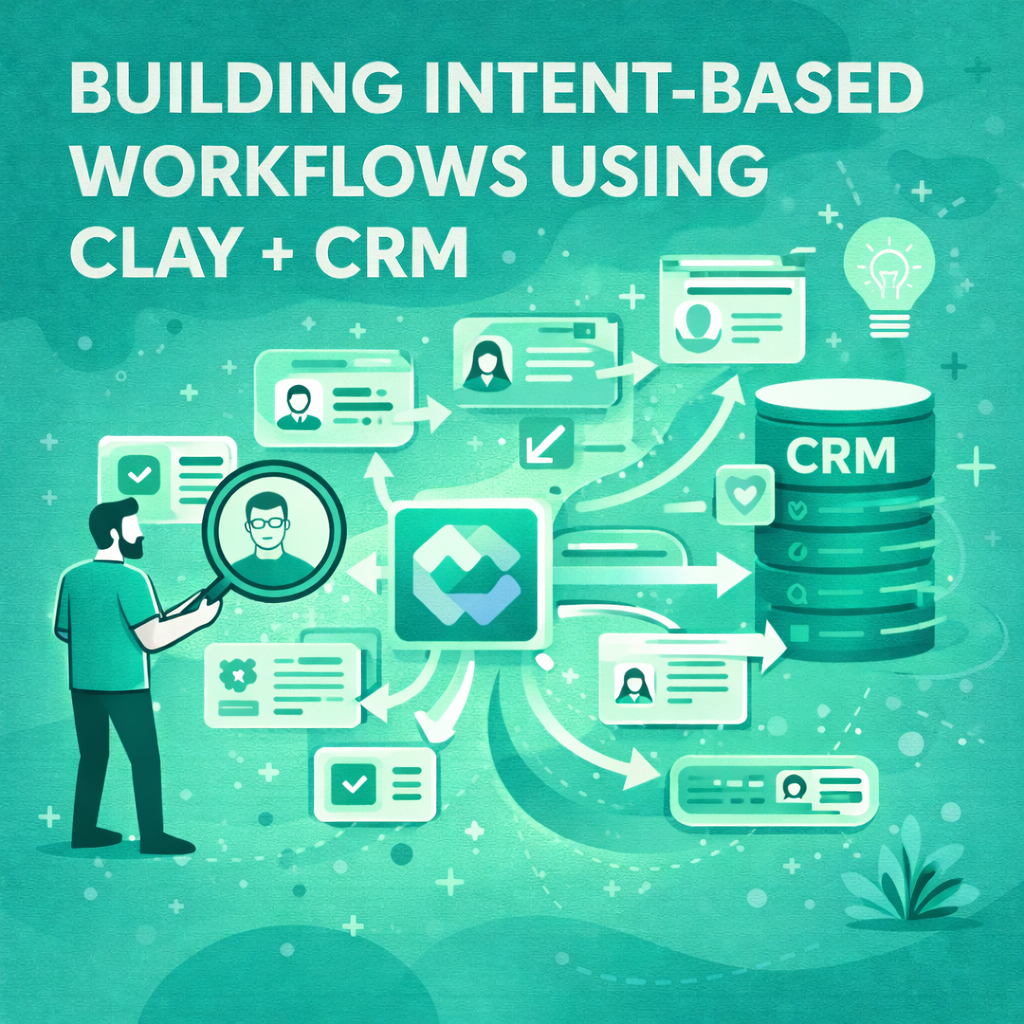
Building Intent-Based Workflows Using Clay + CRM
Building scalable revenue operations today requires more than static tools or isolated processes. Organisations operate across multiple channels, diverse data sources, and fast-moving customer journeys. In this environment, Clay CRM Automation has emerged as a flexible, highly dynamic way to unify data, streamline processes, and enable context-rich engagement across go-to-market teams.
This guide presents an informed, balanced, and educational overview of how Clay supports intent-based workflows, outbound enrichment, and advanced sales automation. It explains how to build workflows with Clay and your CRM to create a more predictable, intelligence-driven GTM engine.
Understanding Clay’s Role in Modern CRM and GTM Operations
Clay operates as a programmable data engine rather than a traditional automation tool. Instead of relying on static lists or fixed triggers, it builds dynamic pipelines that respond to real-time behaviour and to enriched data from more than 100 sources.
This approach allows teams to unify prospect research, enrichment, segmentation, and outreach within a single system. Organisations using Clay often move away from fragmented tech stacks and adopt one central workflow logic capable of:
- Consolidating data from multiple enrichment providers
- Automating cross-team workflows
- Reducing manual research time
- Supporting context-rich conversations with prospects
Clay’s framework is built on the FETE model: Find, Enrich, Transform, Export, enabling teams to create intelligent flows that continuously refresh themselves with new data.
Why Clean CRM Data Is Essential for Workflow Accuracy
CRM systems are often limited by incomplete records, duplicated entries, or outdated contact details. Clay CRM automation provides a structured way to solve this by integrating automated enrichment, validation, and hygiene checks.
Common issues Clay helps eliminate include:
- Outdated job titles or invalid emails
- Duplicate contacts across multiple lists
- Missing firmographic or technographic fields
- Outdated company information, such as funding rounds or employee count
- Siloed data between sales, marketing, and customer success
A structured CRM enrichment workflow ensures every lead record is updated in real time. Enriched records enable teams to segment more effectively, measure account quality, and route opportunities accurately.
This hygiene foundation is necessary before deploying advanced intent-based workflows or high-volume sales automation.
Intent Signals: Turning Behaviour Into Actionable Intelligence
One of Clay’s strongest capabilities is combining behavioural data with enrichment logic to identify real buying intent. Clay intent signals for automation can originate from several sources, including:
Website engagement through web-intent tracking
Job postings that reflect internal growth
Funding announcements that indicate new budgeting cycles
Social conversations from LinkedIn or Reddit
Technology updates or migrations
Engagement with industry content
Clay identifies these signals, enriches them through multi-provider lookups, and routes the information into CRM, Slack, or outbound tools. This minimises delays between signal detection and sales follow-up.
Examples of high-value intent indicators:
Visiting a pricing page for more than thirty seconds
Repeated visits from one company within a short time
Hiring for roles aligned with the product’s use case
Recently raised capital and expanding into new markets
Public posts discussing operational challenges
Signals can be layered to increase accuracy, such as “Series B companies hiring SDR roles and researching sales tools.” These compound signals strengthen the sales pipeline by focusing efforts on accounts with measurable buying interest.
Outbound Enrichment and Real-Time Prospect Identification
Traditional prospecting often leads to low response rates due to outdated lists or generic messaging. Clay improves this process through its multi-provider enrichment system, enabling outbound enrichment at scale.
Clay’s outbound data engine can:
- Identify key decision-makers
- Validate email accuracy
- Pull LinkedIn profiles
- Extract company context, such as product launches or hiring trends
- Check for prior CRM records
- Identify existing opportunities or account owners
- Collect firmographic and technographic data
This unified enrichment process reduces manual research and strengthens sales automation workflows by keeping prospect lists accurate and up to date.
How to Build Workflows with Clay and CRM: A Practical Framework
A structured approach ensures Clay workflows deliver measurable value. The outline below provides a neutral, educational roadmap for teams learning to build workflows with Clay and CRM.
Step 1: Define the ICP Using Real-Time Filters
Use multi-source logic to ensure precision, such as
Industry and sub-industry
Company size
Technology stack
Revenue band
Region
Growth stage
Hiring velocity
Saving these filters as dynamic templates creates continuously refreshing prospect lists.
Step 2: Capture Buying Signals with Trigger Logic
Clay automates signal extraction by monitoring:
Funding announcements
Job postings
Keyword mentions across LinkedIn
Website visitor data
RSS feeds
Competitor comparisons
These signals are then routed into an enrichment flow.
Step 3: Automate Multi-Layer Enrichment
Clay enriches each account and contact through:
Verified emails
LinkedIn URLs
Role verification
Company data
Tech stack identification
Funding or hiring status
AI-powered research via Claygent adds context unavailable in standard databases.
Step 4: Route Qualified Records to Sales in Real Time
Routing options include:
Slack notifications
CRM updates
Automatic account assignment
Lead scoring adjustments
Triggered outreach sequences
This ensures the right person receives the correct information at the right time.
Step 5: Personalise Messaging Using AI
Clay integrates with LLMs to generate messaging based on enriched data, such as:
Recent posts from the prospect
Company announcements
Technology usage
Industry challenges
Roles and responsibilities
The result is scalable personalisation based on validated data rather than assumptions.
Step 6: Measure, Review, and Iterate
Continuous improvement is achieved by analysing:
Signal performance
Enrichment accuracy
Outreach response patterns
Conversion rates
Message variations
Clay’s modular design allows teams to update workflows without rebuilding them entirely.
Where Clay Fits in the Modern Martech Landscape
Companies exploring streamlined automation strategies can review additional insights at SJ Curve. Resources such as the strategic advisory article on navigating the martech landscape, available on the SJ Curve website, provide further context for choosing the exemplary automation architecture.
Reading more at sjcurve.com or its Martech Landscape Guide can help organisations standardise workflow logic and optimise CRM-led operations.
Key Benefits of Clay CRM Automation
1. Enhanced Data Quality
Automated updates minimise errors, outdated records, and silos.
2. Higher Engagement Rates
Personalised outreach improves relevance and increases response likelihood.
3. Real-Time Sales Acceleration
Immediate alerts reduce delays between signal detection and follow-up.
4. Consolidated Tech Stack
Multiple enrichment, research, and routing tools can be replaced by a single workflow engine.
5. Strategic Decision-Making
Continuous intelligence improves forecasting and segment prioritisation.
Conclusion
Clay CRM automation provides a structured, neutral, and data-driven approach to modern go-to-market execution. Through its ability to unify enrichment, intent detection, routing, and personalised messaging, it supports teams in building scalable pipelines grounded in data accuracy and real-time intelligence.
By implementing intent-based workflows, adopting continuous outbound enrichment, leveraging sales automation, and understanding how to build workflows with Clay and CRM, organisations can create a more informed and predictable revenue engine.
The result is a modern GTM system that enables teams to work with clarity, precision, and consistent data accuracy, empowering them to engage prospects at the right moment and with the proper context.