


- Posted on
- Shaheryar Khan
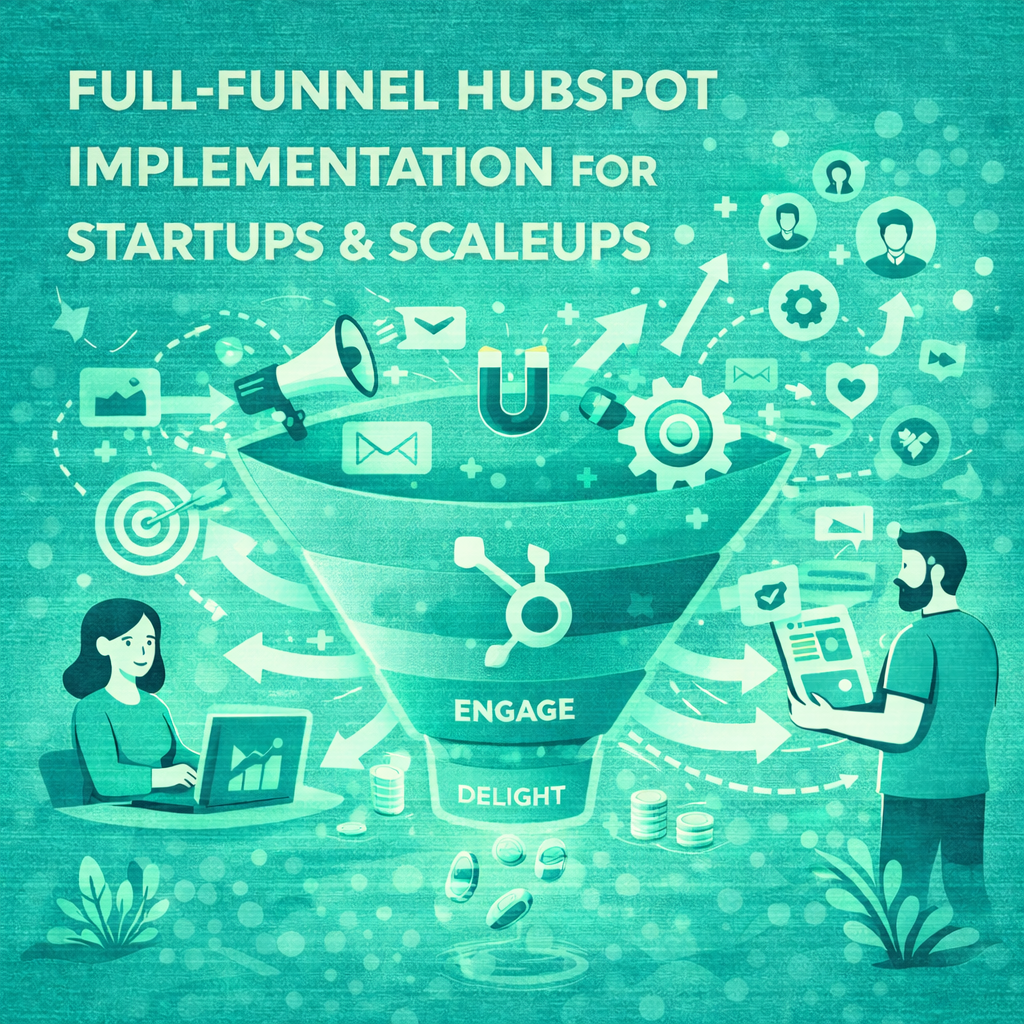
Full-Funnel HubSpot Implementation for Startups & Scaleups
For startups and scaleups, leveraging a powerful CRM like HubSpot is fundamental for growth. A well-executed HubSpot implementation allows you to manage customer relationships, automate marketing efforts, and drive sales. However, to truly unlock its potential, a full-funnel approach is required—one that captures every customer interaction. This is where Google Tag Manager (GTM) becomes an indispensable partner to your HubSpot platform.
Integrating GTM provides the granular tracking needed to understand user behavior across the entire customer journey. This guide will walk you through the process, ensuring your HubSpot setup for scaleups is built on a foundation of clean, actionable data from the very beginning.
Why Google Tag Manager Matters for HubSpot
Google Tag Manager is a powerful tool that allows you to manage and deploy marketing tags (snippets of code or tracking pixels) on your website without having to modify the code. For startups and scaleups, the benefits are significant:
- Flexibility and Speed: GTM empowers your marketing team to add or update tracking codes quickly, without relying on developer resources. This agility is crucial when you need to test new tools or launch campaigns rapidly.
- Centralized Tag Management: All your tracking scripts—from Google Analytics to social media pixels—are managed in one central dashboard. This simplifies organization and reduces the risk of errors.
- Enhanced Tracking Capabilities: GTM allows for advanced tracking setups, like custom event tracking, which helps you gather deeper insights into user engagement within your HubSpot ecosystem.
By using GTM, we can build a more robust marketing automation HubSpot strategy that adapts to your evolving business needs.
Step-by-Step GTM and HubSpot Setup
Integrating GTM with HubSpot is a straightforward process. Our team collaborates with you to ensure this initial setup is flawless, creating a solid base for your analytics.
1. Create a Google Tag Manager Account
First, we establish a GTM account for your business.
- Navigate to the Google Tag Manager website and create a new account.
- Set up a “container” for your website. A container holds all the tags, triggers, and variables for your site.
- Once created, GTM will provide two code snippets. These need to be added to the <head> and <body> sections of your website’s code.
2. Connect GTM with Your HubSpot Instance
Next, we link your new GTM container with HubSpot.
- In your HubSpot portal, navigate to Settings > Website > Pages.
- Select the domain you wish to apply the tracking code to.
- Under the Integrations tab, paste your GTM Container ID into the designated field.
- HubSpot will then automatically add the necessary GTM script to all pages hosted on that domain.
Implementing Tracking and Custom Events
With GTM and HubSpot connected, we can begin tracking user interactions. This is essential for understanding your HubSpot full funnel performance.
Setting Up Basic Tracking
We start by implementing standard tracking to monitor essential user actions:
- Page Views: GTM’s built-in tags can track when a user visits a page.
- Link Clicks: Triggers can be configured to fire when users click on specific links or buttons.
- Form Submissions: We can set up triggers to track when a HubSpot form is successfully submitted, providing clear data on lead generation.
Implementing Custom Events
To capture more specific interactions, we create custom events. For example, we might track:
- Video plays on your landing pages.
- Downloads of a whitepaper or case study.
- Interactions with specific website modules.
This level of full funnel automation in HubSpot provides visibility into which content is resonating with your audience and driving conversions.
The Importance of Analytics Governance
Accurate data is the bedrock of effective decision-making. Without proper analytics governance, your data can become messy and unreliable, leading to flawed insights.
Establishing a governance framework from the start is a priority for our team. We ensure that:
- A consistent naming convention is used for all tags, triggers, and variables.
- Documentation is maintained to keep a clear record of your tracking setup.
- Regular audits are performed to remove obsolete tags and verify data accuracy.
This structured approach ensures your CRM for startups provides trustworthy data to guide your growth strategy.
Building a Foundation for Growth
A proper HubSpot implementation integrated with Google Tag Manager gives startups and scaleups a powerful analytical advantage. By capturing detailed, full-funnel data, your organization can make informed decisions, optimize marketing campaigns, and accelerate growth. Our team is committed to collaborating with you to build a scalable and reliable marketing automation framework that delivers measurable results.